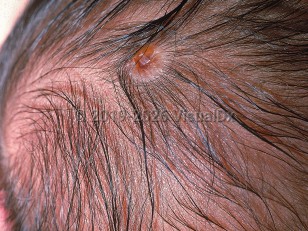
Aplasia cutis congenita (ACC) is a rare, congenital heterogeneous group of disorders that presents as an absence of the skin (dermis and epidermis), most often of the scalp (70%-90%) but it is possible in any skin location. Occasionally, deeper structures, including subcutaneous tissues and underling dura and meninges, may be involved.
ACC usually presents as a single well-circumscribed, weeping or granulating skin defect or an atrophic, depressed scar in the affected area. More than one defect may be present.
Frieden's classification of ACC comprises 9 groups based on the number and location of skin lesions and the presence of associated abnormalities. While usually an isolated finding, ACC has been associated with abnormalities including cleft lip and palate, tracheoesophageal fistula, double cervix and uterus, patent ductus arteriosus, coarctation of the aorta, cutis marmorata telangiectatica congenita, arteriovenous (AV) fistulas, central nervous system (CNS) dysraphism, and intestinal lymphangiectasia.
Although many cases of ACC do not have other associated findings, ACC has been associated with trisomy 13, which should be considered if other signs and symptoms of trisomy 13 are present. ACC may also be seen in Adams-Oliver syndrome, Bart syndrome, Setleis syndrome, focal dermal hypoplasia (Goltz syndrome), and epidermolysis bullosa simplex. It has been associated with defects in other genes affecting several other morphogenic pathways.
Aplasia cutis congenita in Child
See also in: Hair and ScalpAlerts and Notices
Important News & Links
Synopsis

Codes
ICD10CM:
Q84.8 – Other specified congenital malformations of integument
SNOMEDCT:
35484002 – Aplasia cutis congenita
Q84.8 – Other specified congenital malformations of integument
SNOMEDCT:
35484002 – Aplasia cutis congenita
Look For
Subscription Required
Diagnostic Pearls
Subscription Required
Differential Diagnosis & Pitfalls

To perform a comparison, select diagnoses from the classic differential
Subscription Required
Best Tests
Subscription Required
Management Pearls
Subscription Required
Therapy
Subscription Required
References
Subscription Required
Last Reviewed:01/21/2026
Last Updated:01/25/2026
Last Updated:01/25/2026
Aplasia cutis congenita in Child
See also in: Hair and Scalp