Contents

SynopsisCodesLook ForDiagnostic PearlsDifferential Diagnosis & PitfallsBest TestsManagement PearlsTherapyDrug Reaction DataReferences

Information for Patients

View all Images (64)

Lichen sclerosus in Child
See also in: External and Internal Eye,Anogenital
Other Resources UpToDate PubMed

Lichen sclerosus in Child

See also in: External and Internal Eye,Anogenital
Contributors: Antoinette L. Laskey MD, MPH, MBA, FAAP, Belinda Tan MD, PhD, Eric Ingerowski MD, FAAP, Susan Burgin MD
Other Resources UpToDate PubMed

Synopsis

Lichen sclerosus (LS) is a chronic dermatosis that primarily involves the anogenital area. It is characterized by an initial inflammatory phase that is often followed by changes to genital architecture and skin atrophy if left untreated. It is more common in females, with 2 reported peaks of onset, the first in premenarchal girls and the second in postmenopausal women, but it is thought that onset during the reproductive years is likely underrecognized. Childhood and adolescent cases in boys have increasingly been recognized.

The pathogenesis of LS is unknown, but an autoimmune mechanism with genetic predisposition is hypothesized, with an increased prevalence of HLA-DQ7, DQ8, DQ9, and DR12. There is a well-documented association of LS and autoimmune diseases such as alopecia areata, autoimmune thyroiditis, and vitiligo. Some cases are thought to be due to infectious etiology including Borrelia spp and hepatitis C virus.
  • In girls, LS may be asymptomatic, although it often results in pruritus and burning. Additionally, there may be pain on defecation, constipation, dysuria, or anal or genital bleeding. LS commonly affects the vulvar and perianal skin. Lesions typically begin as white or yellow papules and can progress to white plaques with areas of atrophy, friability, and submucosal hemorrhage incited by only minimal trauma or irritation. Chronic LS may lead to obliteration of the normal vulval architecture.
  • The majority of cases of male genital LS occur in uncircumcised males. Lesions originate as white or yellow papules and evolve to atrophic or ivory-white patches, ecchymoses, and sclerosis. LS may be asymptomatic, although it often results in pruritus and burning. Additionally, there may be pain on defecation, constipation, dysuria, or anal or genital bleeding. A major goal of treatment for male pediatric anogenital LS is to prevent urethral stricture. Atrophic LS lesions of the penis are also known as balanitis xerotica obliterans.
Pruritus, at times, can be incapacitating, leading to interference with daily activity and sleep. Children may seek parental attention. They may also present with behavioral changes; for example, caregivers (teachers, parents) may describe a child as "always having their hands in their pants," "rubbing on everything," and "unable to sit still." Behavior caused by itching may be misinterpreted as masturbation that is persistent and resistant to requests to stop.

In children, it is the most common skin condition mistaken for sexual abuse. This most often occurs when the presentation is bullous, hemorrhagic, or erosive. Submucosal hemorrhages ("blood blisters") are rarely due to sexual abuse and are a common finding in LS. The presence of hypopigmentation, atrophic skin, and telangiectasias should help differentiate this condition from sexual maltreatment. Findings of confirmed sexual abuse are primarily associated with acute injuries to the genitalia, anus, or oral cavity, genital scarring, sexually transmitted infections, and hymenal transection or evidence of a deep notch. Case reports of LS coexisting with child abuse have been documented.

LS does not usually resolve with puberty, but it may improve.

Genital LS confers a small risk of squamous cell carcinoma (SCC).

Codes

ICD10CM:
L90.0 – Lichen sclerosus et atrophicus

SNOMEDCT:
895454001 – Lichen sclerosus

Look For

Subscription Required

Diagnostic Pearls

Subscription Required

Differential Diagnosis & Pitfalls

To perform a comparison, select diagnoses from the classic differential

Subscription Required

Best Tests

Subscription Required

Management Pearls

Subscription Required

Therapy

Subscription Required

Drug Reaction Data

Subscription Required

References

Subscription Required

Last Reviewed:04/08/2026
Last Updated:04/09/2026
Copyright © 2026 VisualDx®. All rights reserved.
Patient Information for Lichen sclerosus in Child
Print E-Mail Images (64)
Contributors: Medical staff writer
Premium Feature
VisualDx Patient Handouts
Available in the Elite package
  • Improve treatment compliance
  • Reduce after-hours questions
  • Increase patient engagement and satisfaction
  • Written in clear, easy-to-understand language. No confusing jargon.
  • Available in English and Spanish
  • Print out or email directly to your patient
Copyright © 2026 VisualDx®. All rights reserved.
Lichen sclerosus in Child
See also in: External and Internal Eye,Anogenital
A medical illustration showing key findings of Lichen sclerosus
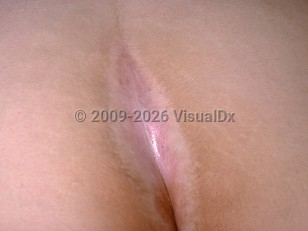
Clinical image of Lichen sclerosus - imageId=174921. Click to open in gallery.  caption: 'A shiny white plaque in the intergluteal fold.'
A shiny white plaque in the intergluteal fold.
Copyright © 2026 VisualDx®. All rights reserved.