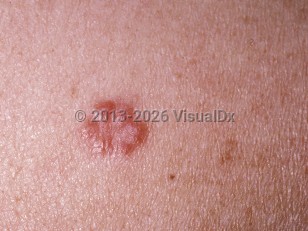
Sarcoidosis is an immune-mediated systemic disorder typified by granuloma formation in involved organs, most commonly of the lung parenchyma and the skin. The inciting immune activating agent remains unknown (hypotheses include autoimmune, infectious, and environmental triggers). There are genetic predispositions related to components of the inflammatory response. Family history of the disease increases the risk. The disease affects all ages and races / ethnicities, with the highest incidence of disease reported in Northern European countries and among Black Americans. Age of peak incidence and sex distribution appears to vary based on population. The disease tends to be more severe in Black Americans, with increased rates of morbidity and mortality.
Oral sarcoidosis is rare. Oral lesions may be isolated or occur in the context of systemic involvement. Any oral surface may be involved, including the lips.
Sarcoidosis commonly presents with abnormalities identified incidentally on chest radiography. Systemic symptoms such as fever, night sweats, and weight loss are common. Sarcoidosis can affect the lungs, with symptoms such as chest pain, shortness of breath, cough, and most commonly, pronounced fatigue. It can also affect the peripheral lymph nodes, heart, kidneys, gastrointestinal tract, central nervous system (CNS), liver, spleen, bone, muscle, and endocrine glands. Venous thromboembolism and pulmonary hypertension are potential complications of sarcoidosis. Approximately 90% of patients will have lung involvement. Pulmonary fibrosis and bronchiectasis result in "honeycombing" of the lung and represent end-stage lung disease due to chronic granulomatous inflammation. Hilar lymphadenopathy is asymptomatic and affects 80% of patients. Approximately 3%-12% of patients have hypercalcemia.
Ten to thirty percent of patients will present with Löfgren syndrome with arthritis, erythema nodosum, and bilateral hilar adenopathy, although rates vary by population. Women more commonly have erythema nodosum, and men more commonly have ankle periarticular inflammation or arthritis.
Neurosarcoidosis commonly manifests as cranial-nerve deficits. Any part of the neurologic system can be impacted by sarcoidosis; a vast range of neurologic signs and symptoms may be present.
Cutaneous disease is often the first sign of systemic sarcoidosis. Approximately 25%-35% of patients will have cutaneous involvement, and some patients may have skin-limited disease. Asymptomatic red-brown dermal papules and/or plaques that favor the face, neck, upper extremities, and upper trunk are the most common specific cutaneous sarcoid lesions.
There are several other morphologic variants of cutaneous sarcoidosis. Lupus pernio, papular / plaque sarcoidosis, hypopigmented macules, ulcerative lesions, psoriasiform sarcoidosis, and scalp sarcoidosis occur more frequently in Black individuals than White individuals.
Mortality associated with sarcoidosis is uncommon. It is generally due to significant granulomatous disease in the lungs and heart, leading to respiratory failure, cardiac arrhythmias, and heart failure. CNS, liver, and renal diseases are also causes of morbidity and mortality.
The pathogenesis of sarcoidosis is poorly understood. However, it is characterized by noncaseating epithelioid granulomas made up mostly of CD4+ helper T cells, a predominantly Th1 type immune response, and elevated levels of interferon (IFN)-gamma and interleukin (IL)-2.
Some drugs and exposures have been associated with the development of sarcoidosis and sarcoid-like granulomatosis. Patients undergoing antiviral therapy for chronic hepatitis C – both monotherapy with IFN-alpha and combination therapy with IFN-alpha and ribavirin – have developed new-onset sarcoidosis or experienced reactivation of preexisting sarcoidosis during or shortly after treatment. The disease typically manifests as pulmonary and/or cutaneous sarcoidosis and follows a benign course, resolving spontaneously or within months after antiviral treatment is completed. More complicated multisystem cases, eg, involving the CNS, have been reported. In addition, there have been an increasing number of reports of new-onset sarcoidosis manifesting in patients who are receiving anti-tumor necrosis factor (TNF)-alpha therapy (etanercept, infliximab, adalimumab), eg, for a rheumatologic diagnosis. This is paradoxical because TNF-alpha inhibitors have been used to treat sarcoidosis. Cutaneous eruptions may occur in up to 50% of these patients, and pulmonary involvement may also be noted. The disease typically resolves with discontinuation of the drug and steroid therapy. It has been reported that exposure to moderate-to-high levels of silica increases the risk for sarcoidosis, which is of special concern for first responders (eg, firefighters). This association is more common in men due to occupational exposure.
Sarcoidosis - Oral Mucosal Lesion
See also in: Overview,External and Internal Eye,Hair and ScalpAlerts and Notices
Important News & Links
Synopsis

Codes
ICD10CM:
D86.9 – Sarcoidosis, unspecified
SNOMEDCT:
31541009 – Sarcoidosis
D86.9 – Sarcoidosis, unspecified
SNOMEDCT:
31541009 – Sarcoidosis
Look For
Subscription Required
Diagnostic Pearls
Subscription Required
Differential Diagnosis & Pitfalls

To perform a comparison, select diagnoses from the classic differential
Subscription Required
Best Tests
Subscription Required
Management Pearls
Subscription Required
Therapy
Subscription Required
Drug Reaction Data
Subscription Required
References
Subscription Required
Last Reviewed:03/25/2026
Last Updated:03/26/2026
Last Updated:03/26/2026
 Patient Information for Sarcoidosis - Oral Mucosal Lesion
Premium Feature
VisualDx Patient Handouts
Available in the Elite package
- Improve treatment compliance
- Reduce after-hours questions
- Increase patient engagement and satisfaction
- Written in clear, easy-to-understand language. No confusing jargon.
- Available in English and Spanish
- Print out or email directly to your patient
Upgrade Today
Sarcoidosis - Oral Mucosal Lesion
See also in: Overview,External and Internal Eye,Hair and Scalp