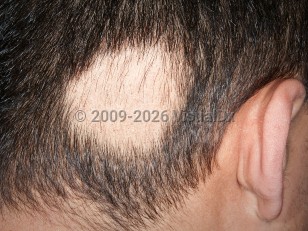
Alopecia areata is a T-lymphocyte-mediated autoimmune disease of the hair follicle resulting in nonscarring hair loss. It is the second most common type of nonscarring hair loss, following male and female pattern alopecia. Most cases are limited to a few small patches of alopecia that involve the scalp, eyebrows, eyelashes, or body hair (patchy alopecia areata), but in severe cases, all hair on the scalp is lost (alopecia totalis) or all scalp and body hair is lost (alopecia universalis). History of sudden onset is characteristic.
Alopecia areata is seen equally in both sexes and occurs in patients of all ages, races, and ethnicities. There is an increased incidence of alopecia areata in patients with Down syndrome as well as those with autoimmune diseases, most commonly thyroid disease. Patients with alopecia areata are also more likely to have atopy, and its presence is felt to be a poor prognostic indicator.
There is a complex interplay of genetic and environmental factors that play a role in the pathogenesis of alopecia areata. While medication-induced alopecia areata has been uncommon in the literature, published articles report an association with some medications, including TNF inhibitors (eg, adalimumab, etanercept, and infliximab). More recently described culprit agents include proton pump inhibitors and immune checkpoint inhibitors (eg, anti-CTLA-4 and anti-PD-1) used to treat malignancies. Alopecia areata following COVID-19 infection and vaccination has also been reported.
The course of alopecia areata is unpredictable, with wide variation in duration and extent of disease occurring from patient to patient. In most patients, hair will eventually spontaneously regrow, although recurrences are common. The condition is treatable but cannot be cured.
Alopecia areata in Adult
See also in: External and Internal Eye,Nail and Distal DigitAlerts and Notices
Important News & Links
Synopsis

Codes
ICD10CM:
L63.9 – Alopecia areata, unspecified
SNOMEDCT:
68225006 – Alopecia areata
L63.9 – Alopecia areata, unspecified
SNOMEDCT:
68225006 – Alopecia areata
Look For
Subscription Required
Diagnostic Pearls
Subscription Required
Differential Diagnosis & Pitfalls

To perform a comparison, select diagnoses from the classic differential
Subscription Required
Best Tests
Subscription Required
Management Pearls
Subscription Required
Therapy
Subscription Required
Drug Reaction Data
Subscription Required
References
Subscription Required
Last Reviewed:02/08/2026
Last Updated:02/08/2026
Last Updated:02/08/2026
 Patient Information for Alopecia areata in Adult
Premium Feature
VisualDx Patient Handouts
Available in the Elite package
- Improve treatment compliance
- Reduce after-hours questions
- Increase patient engagement and satisfaction
- Written in clear, easy-to-understand language. No confusing jargon.
- Available in English and Spanish
- Print out or email directly to your patient
Upgrade Today
Alopecia areata in Adult
See also in: External and Internal Eye,Nail and Distal Digit