Contents

SynopsisCodesLook ForDiagnostic PearlsDifferential Diagnosis & PitfallsBest TestsManagement PearlsTherapyDrug Reaction DataReferences

Information for Patients

View all Images (122)

Other Resources UpToDate PubMed

Keratoacanthoma

See also in: External and Internal Eye,Hair and Scalp
Contributors: Debby Cheng, Jennifer Lee MD, Jeffrey M. Cohen MD, Susan Burgin MD
Other Resources UpToDate PubMed

Synopsis

A keratoacanthoma is a rapidly growing, well-differentiated neoplasm of squamous epithelium. Many consider keratoacanthomas to be a low-grade variant of squamous cell carcinoma (SCC). In contrast to classic SCCs, keratoacanthomas typically appear and grow rapidly over a few weeks and spontaneously involute and resolve within 6 months, leaving an atrophic scar. The immune system is thought to play a role in the spontaneous regression of keratoacanthomas.

Keratoacanthomas are most commonly seen in individuals aged 60 years and older with light skin colors and a history of prolonged sun exposure. Men are more commonly affected than women.

Risk factors for keratoacanthomas include ultraviolet (UV) radiation, human papillomavirus infection, immunosuppression, and certain medications. Patients on immunosuppressant medications tend to have more persistent and chronic keratoacanthomas. Patients taking medications such as BRAF inhibitors or hedgehog inhibitors have also been reported to develop keratoacanthomas. Additionally, with anti-PD-1 / PD-L1 immunotherapy, rare cases of eruptive keratoacanthomas have been documented. Skin injury may also be a predisposing factor, and there are reports of keratoacanthomas developing in sites of prior trauma, in surgical scars, after laser resurfacing, and following radiation therapy. In rare cases, keratoacanthomas may develop as part of a syndrome.
  • In Ferguson-Smith syndrome, patients develop multiple self-healing keratoacanthomas. It is often seen in younger individuals. It is a genetic condition inherited in an autosomal dominant manner.
  • In generalized eruptive keratoacanthomas of Grzybowski, patients develop hundreds to thousands of keratoacanthomas on both the skin and mucous membranes. These keratoacanthomas are frequently chronic and progressive.
  • In Muir-Torre syndrome, patients may develop keratoacanthomas along with sebaceous neoplasms and/or gastrointestinal or genitourinary malignancy.
  • In familial keratoacanthomas of Witten and Zak, patients develop multiple large and small keratoacanthomas; it is inherited in an autosomal dominant fashion.


Codes

ICD10CM:
L85.8 – Other specified epidermal thickening

SNOMEDCT:
254662007 – Keratoacanthoma

Look For

Subscription Required

Diagnostic Pearls

Subscription Required

Differential Diagnosis & Pitfalls

To perform a comparison, select diagnoses from the classic differential

Subscription Required

Best Tests

Subscription Required

Management Pearls

Subscription Required

Therapy

Subscription Required

Drug Reaction Data

Subscription Required

References

Subscription Required

Last Reviewed:03/16/2026
Last Updated:03/29/2026
Copyright © 2026 VisualDx®. All rights reserved.
Patient Information for Keratoacanthoma
Contributors: Medical staff writer
Premium Feature
VisualDx Patient Handouts
Available in the Elite package
  • Improve treatment compliance
  • Reduce after-hours questions
  • Increase patient engagement and satisfaction
  • Written in clear, easy-to-understand language. No confusing jargon.
  • Available in English and Spanish
  • Print out or email directly to your patient
Copyright © 2026 VisualDx®. All rights reserved.
Keratoacanthoma
See also in: External and Internal Eye,Hair and Scalp
A medical illustration showing key findings of Keratoacanthoma
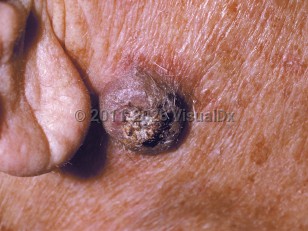
Clinical image of Keratoacanthoma - imageId=213569. Click to open in gallery.  caption: 'A close-up of a violaceous nodule with a central keratotic core.'
A close-up of a violaceous nodule with a central keratotic core.
Copyright © 2026 VisualDx®. All rights reserved.