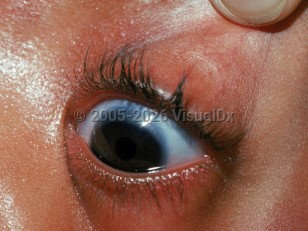
Osteogenesis imperfecta (OI), commonly known as brittle bone disease, refers to a heterogeneous group of inherited qualitative or quantitative defects in collagen type I synthesis, primarily caused by mutations in the COL1A1 and COL1A2 genes, resulting in osteoporosis and frequent fractures. Most cases are autosomal dominant, but some are autosomal recessive. Some spontaneous mutations occur. There are at least 8 recognized forms representing a range of severity. Type I is the mildest and most common form, and type II is the most severe. Typing is based on severity of the disease and underlying genetic defect.
The disorder occurs worldwide but has been reported to have a higher incidence in 2 tribes in Zimbabwe.
Depending on the type of OI, patients may present with fractures in utero or childhood, easy bruising, joint laxity, early onset of deafness, blue-gray sclerae, brittle teeth, scoliosis, long limb deformity, and short stature. Other findings may include hernia, mitral valve prolapse, arterial fragility, pulmonary hypertension, and fragile skin. Complications include orthopedic problems, cerebral hemorrhage due to birth trauma, and basilar or cord compression. Individuals with OI may die of respiratory infections.
Life expectancy depends on the type of IO the individual has. Types I and IV have a slight decrease in life expectancy, while most individuals with type II die within the first year. Individuals with type III have a reduced life expectancy due to skull fractures and respiratory infection, but they have a reasonable prognosis if surviving beyond age 10 years.
Osteogenesis imperfecta in Adult
Alerts and Notices
Important News & Links
Synopsis
Codes
ICD10CM:
Q78.0 – Osteogenesis imperfecta
SNOMEDCT:
78314001 – Osteogenesis imperfecta
Q78.0 – Osteogenesis imperfecta
SNOMEDCT:
78314001 – Osteogenesis imperfecta
Look For
Subscription Required
Diagnostic Pearls
Subscription Required
Differential Diagnosis & Pitfalls

To perform a comparison, select diagnoses from the classic differential
Subscription Required
Best Tests
Subscription Required
Management Pearls
Subscription Required
Therapy
Subscription Required
References
Subscription Required
Last Reviewed:01/29/2026
Last Updated:02/01/2026
Last Updated:02/01/2026
Osteogenesis imperfecta in Adult